“I LOVE YOU WITH ALL MY HEART!”
| author: rrfranksValentine’s Day is soon approaching and many men will purchase for their wives or girlfriends tokens of their love such as cards, boxes of heart shaped candy or even flowers! Such a tradition is good in that it allows men to back up their statements of “I love you!” with tangible expressions of love to the one they care for deeply. While a woman likes to be told by her man that he loves her (and she likes to be told a lot by the way), she also likes to be shown that love as well. A wise man is one who backs up his words with his actions! Valentine’s Day is just one of many opportunities to demonstrate such love.
While Valentine’s Day seems to primarily bring to mind thoughts of romantic love, it does not have to be limited to that. This holiday season I would like us to also think about our love for God. Do you love God? You may quickly say, “Yes I love God! He sent His only begotten Son to die for my sins, of course I love Him!” Such expressions of love to God are all well and good, but how do we express that love? What are tangible ways that we show God that we love Him?
As we grow in our faith our love for God grows as well. It is a great gift of God when as the years go by, we grow to love Him more. But such love flows from a heart that is changing; that is being made more like the Lord Jesus Christ. Let me ask you, what is the condition of your heart? Don Cousins gives Ten Signs of a Healthy Heart; a heart or life that demonstrates its love to God:
1. A tongue that blesses. An unhealthy heart is a tongue that is vile, negative, and cursing. The words we speak say a lot about the condition of our heart. Matthew 12:34—“For out of the overflow of the heart the mouth speaks.”
2. Thoughts that are pure. When your mind is free to wander, what are you thinking about? Matthew 15:19—“For out of the heart come evil thoughts, murder, adultery, sexual immorality, theft, false testimony, slander.”
3. Thankfulness…in all things. I Thessalonians 5:16-18—Be joyful always; pray continually; give thanks in all circumstances, for this is God’s will for you in Christ Jesus.”
4. A peace-filled spirit. Ephesians 4:31-32—Be kind and compassionate to one another, forgiving each other, just as in Christ God forgave you.” Colossians 3:15—Let the peace of Christ rule in your hearts, since as members of one body you were called to peace.” How is your anger level these days? How are your irritations these days?
5. A desire to worship God. Psalm 96:9—“Worship the Lord in the splendor of His holiness.” Is worship filling your heart? The more you pray, the more you pray. The more you worship, the more you worship.
6. Contentment in all circumstances. Philippians 4:11—“I am not saying this because I am in need, for I have learned to be content in all circumstances.” Are you satisfied with what God has given you?
7. A hunger for God’s Word. Psalm 119:9—“How can a young person live a pure life? By obeying your Word.”
8. Demonstrated humility. James 4:6—But he gives us more grace. That is why Scripture says: ‘God opposes the proud but gives grace to the humble.’” How much of your life starts with self?
9. A commitment to personal holiness. II Timothy 2:22—Flee the evil desires of youth, and pursue righteousness, faith, love and peace, along with those who call on the Lord out of a pure heart.” True holiness is to walk in faith.
10. Whole-hearted devotedness to the Lord. I John 5:21—Dear children, keep yourselves from idols.” Anything you have to add to Jesus is an idol. What threatens your devotion to the Lord?
Of course all these 10 signs could easily be summarized by Jesus’ statement in John 14:15 which says, “If you love Me, you will keep My commandments”. This Valentine’s Day season let us respond to God’s great love for us by loving Him back with all our heart and soul and mind and strength (Mark 12:30)!
ANOTHER YEAR, ANOTHER LIST
| author: rrfranksWith the coming of the New Year I have become increasing aware of how our culture does everything it can to persuade us not to think, but simply to be satisfied to be entertained. It is so easy to spend hours surfing the web, watching TV or even listening to music on one's mp3 player. Let me challenge you though, to take more time feeding your mind by increasing the amount of time you spend reading and pondering. I encouraged you to set some goals for your reading; not only in the amount of books you read, but in the types as well. As Ligon Duncan points out,
…you want to be reading what the Puritans would have called "soul-fatting" books: works that will increase your knowledge, your love for the Lord and your confidence in Scripture. You will, of course, from time to time read things that are not soul-fatting, but you must never allow this best kind of book to be entirely absent from your normal plan of reading (http://blog.t4g.org/2006/02/pastors_studyin_1.html).
This is a good reminder as Christians are prone to simply read what is on the latest Christian best seller reading list; whether it is "soul-fatting" reading or not. To get into the habit of reading only that which is in the Christian top 50 is a poor habit; much like that of living on junk food. C.S. Lewis points out that it is not good to read only modern books, but one should also read old books:Naturally, since I myself am a writer, I do not wish the ordinary reader to read no modern books. But if he must read only the new or only the old, I would advise him to read the old. And I would give him this advice precisely because he is an amateur and therefore much less protected than the expert against the dangers of an exclusive contemporary diet. A new book is still on its trial and the amateur is not in a position to judge it. It has to be tested against the great body of Christian thought down the ages, and all its hidden implications (often unsuspected by the author himself) have to be brought to light. Often it cannot be fully understood without the knowledge of a good many other modern books….
… The only safety is to have a standard of plain, central Christianity ("mere Christianity" as Baxter called it) which puts the controversies of the moment in their proper perspective. Such a standard can be acquired only from the old books. It is a good rule, after reading a new book, never to allow yourself another new one till you have read an old one in between. If that is too much for you, you should at least read one old one to every three new ones
(http://blog.t4g.org/2006/02/pastors_studyin_1.html).
In order to help you get started on your endeavor let me suggest a list of books that you might consider. If you are not an avid reader then do not worry, but take heart. Rather than trying to read all these books, pick out 6 or even 3 that you will read in 2010.
The Quest for More by Paul David Tripp (both book and discussion guide) - Tripp demonstrates though sound biblical principles how humanity is made by God to transcend far beyond the mere physical realm and is likewise created to be "glory junkies;" those whose visionary lives are governed by God's grand purposes rather than existing only within their narrow self-interested confines. Paul Tripp expertly traverses the deepest recesses of the human heart and compassionately invites fellow Christian travelers to journey with him into God's bigger kingdom. The author promises readers that they will be encouraged, excited, and motivated by hope as they learn how to set aside their "little kingdom" attachments which can expertly masquerade within the church as Christian activism, legalism, emotionalism, formalism, creedalism, and externalism; in favor of God's expansive and soul-freeing eternal quest.
Making Kingdom Disciples: A New Framework by Charles H.
Dunahoo -- In much of the church one-sided discipleship has produced one-sided disciples. Such believers often divorce Sunday from the work week, religious feeling from intellectual rigor, or personal practice from the public square. To redress these imbalances, Making Kingdom Disciples proposes a holistic, kingdom-oriented approach to discipleship. Drawing on years of experience in Christian education at the pastoral and denominational level, Dunahoo calls churches to train disciples to "think God's thoughts after him" in all of life: business, education, politics, recreation. Drawing deeply from the Reformed tradition, he orients readers to overarching concepts such as kingdom, epistemology, covenant, and worldview together with their eminently practical implications. The work as a whole serves to root anew our discipleship efforts upon a biblical foundation with a sensitivity to today's modern and post-modern generations. This is a must read for anyone who makes disciples!
Why We Love The Church by Kevin DeYoung & Ted Kluck – Community is hip, but the church is lame. Both inside the church and out, organized religion is seen as oppressive, irrelevant, and a waste of time. Outsiders like Jesus, but not the church. Insiders have been told they can do just fine with God apart from the church. Yet Kevin DeYoung and Ted Kluck paint a picture of the local church in all its biblical and real life guts, gaffes, and glory in an effort to edify local congregations and counteract the "leave church" books that trumpet rebellion and individual felt needs. They remind us that being part of a church---and learning to live it—is good for your soul, biblically responsible, and pleasing to God.
Worldly Saints by Leland Ryken – This is a very persuasive & interesting book; offering a good introduction to seventeenth-century Puritanism. The typical Puritans were not wild men, fierce and freaky, religious fanatics and social extremists, but sober, conscientious, and cultured citizens, persons of principle, determined and disciplined. Dr. Ryken's presentation of the Puritan view and style of life is perceptive and accurate. He allows the Puritans to speak for themselves on topics ranging from "Church and Worship" to "Money" and "Marriage and Sex.
Penned as dialogue between a minister(Evangelista), a young Christian(Neophytus), a legalist(Nomista) who believes Christianity is a set of rules to be obeyed and Antinomista who thinks it's okay to sin because God will forgive him anyway, it makes for a wonderfully insightful book that remains tremendously relevant for our world today.
God At Work: Your Christian Vocation in All of Life by Gene Edward Veith, Jr. -- Culture expert Gene Veith unpacks the biblical, Reformation teaching about the doctrine of vocation, emphasizing not what we should specifically do with our time or what careers we are called to, but what God does in and through our callings--even within the home. In each task He has given us--in our workplaces and families, our churches and society--God Himself is at work. Veith guides you to discover God's purpose and calling in those seemingly ordinary areas by providing you with a spiritual framework for thinking about such issues and for acting upon them with a changed perspective.
- Lost in the Middle: Midlife and the Grace of God by Paul David Tripp
- Blame It On The Brain? By Edward T. Welch
- Cross Talk: Where Life & Scripture Meet by Michael R. Emlet
- The Walk by Stephen Smallman
- Robert E. Lee on Leadership by H.W. Crocker III
- Precious Remedies Against Satan's Devices by Thomas Brooks
- Broken Down House by Paul David Tripp
Happy reading in 2010!!!!
‘Tis the Season...for Suffering?
| author: rrfranksThanksgiving is over. The relatives have all gone home. The turkey and dressing is but a memory but the holidays are far from over. There is much to do in anticipation of Christmas, so 'tis the season...for suffering?
What do Christmas and suffering have to do with each other? Isn’t Christmas to be a time of joy and celebration, gifts and family? One might possibly entertain the idea of “suffering” in relation to the holidays if you count fighting the crowds at the after Thanksgiving Day sales or attending the endless holiday activities that plague one’s calendar. But other than that, why would Christmas be considered the Season for Suffering?
James Montgomery Boice, former Pastor of Tenth Presbyterian Church (PCA) in Philadelphia and now a saint worshipping God face to face in glory, once made the following comment on suffering:
When Life is smooth it is easy to say, as we often do, “all things work together for good to them that love God.” It is easy when you have everything you want, when God blesses you and your family. But it is not so easy at the grave. It is not so easy in the face of bitter disappointment and pain. If you are to have confidence in God in such moments, you must learn to trust Him in the small disappointments of life. (Commentary on Philippians by James Boice, p. 66).
What is ironic about this statement is that James Boice made it in connection with Philippians 1:19-20 where Paul says,
19 for I know that this will turn out for my deliverance through your prayers and the provision of the Spirit of Jesus Christ, 20 according to my earnest expectation and hope, that I will not be put to shame in anything, but that with all boldness, Christ will even now, as always, be exalted in my body, whether by life or by death. – Phil 1:19, 20 (NASB)
Boice points out that, “Paul recognized that Christ would be magnified in him whether he lived or died. This means Paul was so confident that God’s will for him was perfect—that it was the best possible thing for him—that he was able to accept it willingly even if it meant death at the hands of a Roman executioner” (Philippians, p. 66). Paul trusted God in the disappointments of life; both small & large!
Not only did Paul face suffering confidently because of his trust in God, but just one chapter later in Philippians we read,
5 Have this attitude in yourselves which was also in Christ Jesus, 6 who, although He existed in the form of God, did not regard equality with God a thing to be grasped, 7 but emptied Himself, taking the form of a bond-servant, and being made in the likeness of men. 8 Being found in appearance as a man, He humbled Himself by becoming obedient to the point of death, even death on a cross. – Phil 2:5-8 (NASB)
Jesus emptied Himself, being made in the likeness of men; being born as a baby in the cattle pen and lying in a manger. Jesus grew to manhood; obeying God in everything even to the point of death; death on a cross.
The incarnation of Christ that we celebrate at Christmas reminds us that we have a God who has suffered on our behalf! And the reality that Christ suffered as we suffer gives us great comfort. Paul could stand firm even in the face of death because he knew that he could trust His God. God is not a God who calls us to do something that He is unwilling to do. God is a God of comfort; especially in difficult times (Psa. 23:4; 119:50; Isa 12:1; 2 Cor 1:3-7; 2 Thess 2:16 & 17).
As Boice reminds us, Christians cannot erase the suffering or wish it away by telling people that “all things work together for good to them that love God.” (Rom. 8:28). No! We must resist the temptation to “fix” people and give them glib answers to difficult questions. Trusting God comes as one trusts in God in the small disappointments of life. Then, as greater suffering occurs, one will be more likely to stand fast in Him!
So what are we to do when we encounter those suffering souls this holiday season? We must remind them of the truths of Scripture. We must share with or remind them that there is a God who understands their suffering; a God who, Himself suffered on their behalf that they might be set free to trust Him even in the midst of the suffering that they currently encounter. That He is the God of all comfort. That He did not carry out His plan of salvation from afar, but He came to earth, suffered the injustices of a fallen people and fallen world, and rose victorious that we might be set free from sin and death and instead have new life!
This Christmas season, let us all remember that for many around us, ‘Tis the Season for Suffering. But also let us remember that Jesus came to earth, suffered on our behalf to set us free from the power of sin that we might trust Him; even in the midst of suffering!
Let me close with the words of the Apostle Paul in 2 Corinthians 1:3-7,
3 Blessed be the God and Father of our Lord Jesus Christ, the Father of mercies and God of all comfort, 4 who comforts us in all our affliction so that we will be able to comfort those who are in any affliction with the comfort with which we ourselves are comforted by God. 5 For just as the sufferings of Christ are ours in abundance, so also our comfort is abundant through Christ. 6 But if we are afflicted, it is for your comfort and salvation; or if we are comforted, it is for your comfort, which is effective in the patient enduring of the same sufferings which we also suffer; 7 and our hope for you is firmly grounded, knowing that as you are sharers of our sufferings, so also you are sharers of our comfort. – 2 Cor. 1:3-7 (NASB)
May God use us this holiday season as instruments in His hands to bring the hope of the gospel to those with whom we come in contact.
Thanksgiving 2009
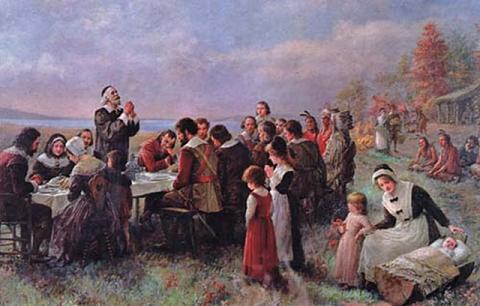
| author: rrfranksHappy Thanksgiving Everyone!!!
Oh give thanks to the LORD, for He is good, For His lovingkindness is everlasting.
-- Psalm 107:1
New Addition to Our Blog List
| author: rrfranksThank you so much for stopping by Frankly Speaking! We hope that while you are here that you will not only take time to read our posts, but also to check out some of the blogs on our blog list. These blogs have been an encouragement to us and we think that you may profit from them as well. We have a new blog on our list that we commend to you called Heidelblog (catchy name isn't it). Also, do not forget to check out their podcast entitled Heidelcast.
Subscribe to:
Posts (Atom)